
Review · MUMBAI BY BICYCLE
Best Bicycle Tour In Mumbai
Mumbai starts early, and this bike loop matches that pace. You’ll roll from Colaba toward major heritage sights while the city is still waking up, then end with sea views and dock-area atmosphere. I like that the tour is short enough to fit a packed itinerary, yet long enough for a real sense of how South Mumbai connects—monuments, institutions, and street life all in one ride.
Two things I especially like: the guided storytelling. You hear why places matter, not just what they look like. And the stops are mostly free to enter, so you’re paying for the ride and the guide more than an attraction lineup. One drawback to keep in mind: bike comfort and safety can depend on your comfort with traffic and crossings, so if you’re a nervous rider, choose your pace carefully and ask what safety gear is available before you go.
In This Review
- Key highlights you’ll feel on the handlebars
- Why a 3-hour morning bike tour works in South Mumbai
- Price, value, and what you’re really paying for
- Getting started at Kailash Parbat in Colaba
- The ride itself: a practical loop with major landmarks
- Gateway of India: where the sea starts the story
- Taj Mahal Palace: architecture you can read from a distance
- Chhatrapati Shivaji Maharaj Vastu Sangrahalaya: Indo-Saracenic details
- Rajabai Clock Tower: a classic landmark moment
- Bombay High Court: institutional Mumbai, explained
- Chhatrapati Shivaji Terminus area (formerly Victoria Terminus)
- Brihanmumbai Municipal Corporation building: heritage near the terminus
- Crawford Market and the market streets: real South Mumbai life
- The clothing market area and nearby bazaars
- Mumba Devi Temple: devotion that feels old
- Bombay Panjrapole: cow protection meets cultural context
- Jain temple / Derasar: small stop, specific religion
- Marine Drive: the C-shaped promenade by the sea
- Sassoon Dock: heritage docks from the wet dock era
- Guides and pacing: why Roy and Kurtin stand out
- Safety and comfort: what you should check before you pedal
- Who this tour is best for
- Should you book this Mumbai bike tour?
- FAQ
- How long is the bicycle tour in Mumbai?
- How much does the tour cost?
- Where does the tour start, and does it end there too?
- Are admission tickets included?
- Is pickup offered, and do I get a mobile ticket?
- What is the minimum age and group size?
- What is the cancellation policy?
Key highlights you’ll feel on the handlebars
- Sunrise views at the Gateway of India give the whole ride a strong start, with the Arabian Sea setting the mood.
- Free admission at major heritage stops means your $39 is mostly for guide time and transportation value.
- Small groups (up to 12) make it easier to stay together and actually hear the guide.
- Markets and temple stops add texture beyond the postcard monuments, including Crawford Market and Mumba Devi Temple.
- A cow-protection stop at Bombay Panjrapole adds cultural meaning to the ride.
- Marine Drive and Sassoon Dock round out the loop with sea-and-city atmosphere.
Why a 3-hour morning bike tour works in South Mumbai
South Mumbai is the kind of place where you can spend days just looking at buildings. The smart move is to target the main threads—coastal landmarks, big institutions, and the old market spine—without wasting half your day inside transport.
This tour is about 3 hours, and that timing matters. You get enough time for a real route arc, but you’re not trapped into a full day when your energy might be better spent on neighborhoods later. It also runs in the morning, which helps you see the city while it still feels ordered, before the day’s crush takes over.
Price, value, and what you’re really paying for
At $39 per person, this is positioned as a budget-friendly way to cover serious sights in one loop. The value isn’t only the price tag; it’s the structure: a guided route, a small max group size, and a lineup where most stops list free admission tickets.
That matters because in big cities, even a handful of paid entries can start adding up. Here, you’re mainly paying for a human guide to connect the dots between places like the Gateway of India, the High Court area, and the heritage station zone around Chhatrapati Shivaji Terminus.
Also, the tour is commonly booked about 53 days in advance. That’s a hint it can fill up, especially if you’re traveling during busy seasons. I’d plan to book ahead rather than waiting.
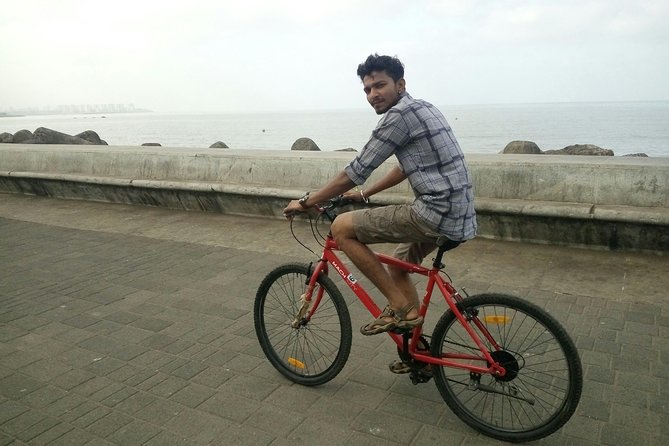
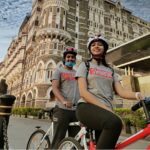
More saddle time on Mumbai's quietest early roads


Getting started at Kailash Parbat in Colaba
You meet at Kailash Parbat Hindu Hotel N Restaurants in Colaba (Sheila Mahal Society Shop no 5, 1st Pasta Lane, Apollo Bandar, Colaba). The nice thing is that the experience ends back at the meeting point, so you don’t have to figure out a second logistics puzzle after you’re done.
If pickup is offered for your booking, that can save you time and stress—especially early in the day. And you get a mobile ticket, which is one less thing to print or misplace.
The ride itself: a practical loop with major landmarks
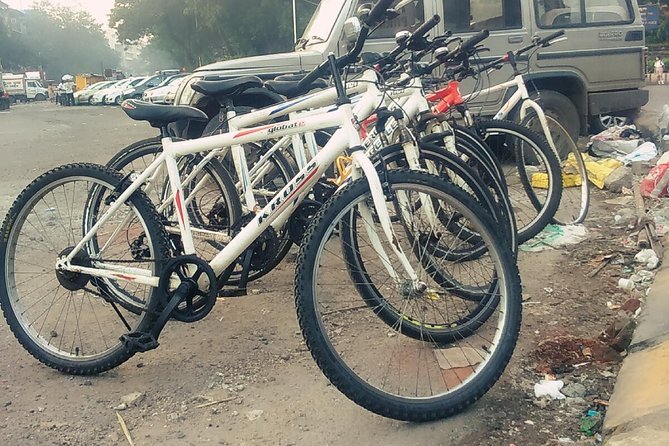
This is a guided cycle through the southern stretch of Mumbai. The pace is set for a group, and the route links big-name heritage sites with everyday city places, so you get both the big architecture and the lived-in Mumbai feel.
Below is what you can expect, stop by stop, and what each one adds to the ride.
Gateway of India: where the sea starts the story
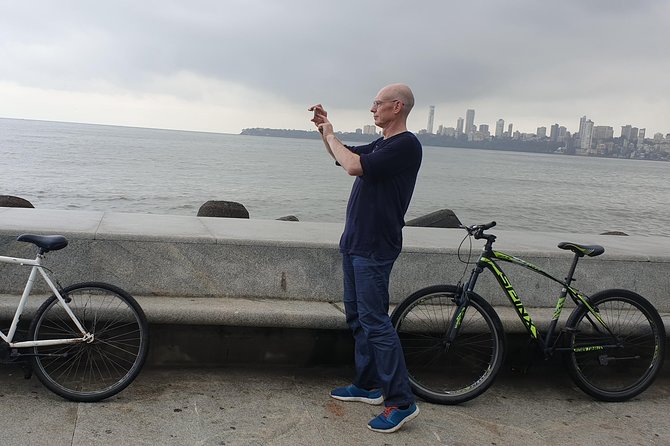
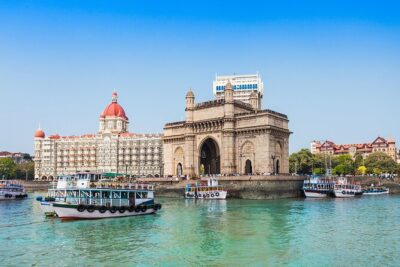
You begin at the Gateway of India, and the tour is timed for morning energy. One of the best moments is the chance to see the sunrise over the Arabian Sea from this area.
This stop works because it anchors everything that comes later. The Gateway isn’t just a landmark; it’s a coastal gateway point that helps you understand Mumbai’s relationship to the water and the movement of people.
- Dharavi slum tour in Mumbai by Female tour guides of the slum
★ 5.0 · 1,976 reviews - Mumbai: Full-Day Sightseeing Tour of Mumbai
★ 4.9 · 1,822 reviews - Private Mumbai Sightseeing Tour (Traveller’s Choice Award Winner)
★ 5.0 · 1,565 reviews - Group Guided Walking Tour in Fort and Colaba
★ 5.0 · 1,073 reviews - Highlights of Mumbai Sightseeing Tour: TRAVELLERS CHOICE AWARDED
★ 5.0 · 915 reviews - Private Guided Walking Tour in Fort & Colaba
★ 5.0 · 895 reviews
Taj Mahal Palace: architecture you can read from a distance
Next comes the Taj Mahal Palace, Mumbai. You approach the hotel and you’ll notice the architecture right away, even before you get close to any details.
The guide’s job here is to connect what you’re seeing to what happened over time. This stop is short, so don’t expect a museum-style deep scan—but you’ll get enough context to make the building feel less like a random photo op.
Chhatrapati Shivaji Maharaj Vastu Sangrahalaya: Indo-Saracenic details
After Taj Mahal Palace, you head to Chhatrapati Shivaji Maharaj Vastu Sangrahalaya. This museum is known for Indo-Saracenic architecture, and from the bike you can still pick up the style cues—the blend of influences is part of the visual lesson.
Short stop means you’re mostly getting a guided orientation: what the building type represents and why this museum sits where it does in the city’s cultural geography.
Rajabai Clock Tower: a classic landmark moment
You see Rajabai Clock Tower from outside. It’s one of those structures that can look simple until someone explains why it matters and how it fits into the heritage zone nearby.
This is a good stop for quick photos plus a bit of backstory. If you like clock towers, you’ll probably linger longer than you think.
Bombay High Court: institutional Mumbai, explained
The High Court of Bombay stop adds an official, civic dimension to the ride. You get context that it’s the high court for Maharashtra and Goa, and for the union territory of Dadra and Nagar Haveli and Daman and Diu.
Seeing this area by bike is useful because it’s not just architecture; it’s how Mumbai organizes power and law in the public space. You’re also learning why these big institutions were placed where they are.
Chhatrapati Shivaji Terminus area (formerly Victoria Terminus)
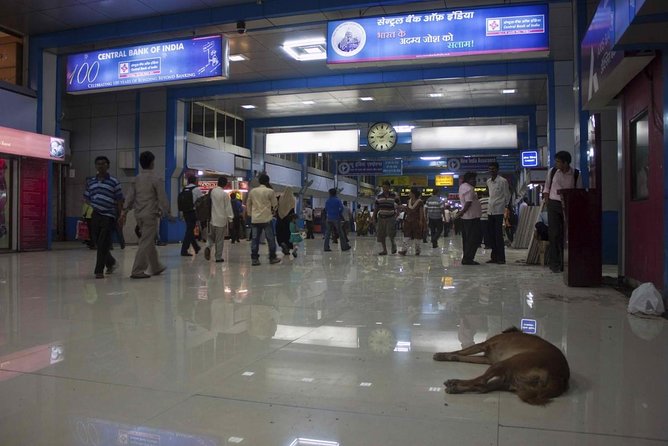
This part of the tour is a highlight for architecture nerds and train-photo fans alike. You reach Chhatrapati Shivaji Terminus—formerly Victoria Terminus Station—and it’s famous for Victorian Gothic Revival architecture with themes derived from Indian design elements.
Even if you don’t go inside, you can still appreciate the scale and the drama. It also gives you a meaningful link to Mumbai’s older transportation story, which pairs well with the docks later on.
Brihanmumbai Municipal Corporation building: heritage near the terminus
From there, you pass the Brihanmumbai Municipal Corporation building. It’s described as a Grade IIA heritage building opposite the Terminus area, so it becomes another piece of the same historic puzzle.
This stop feels like a quick architectural “check-in.” It helps you understand that this isn’t just one famous building; it’s an entire civic zone shaped in the same era.
Crawford Market and the market streets: real South Mumbai life
Now you shift from big institutions to city commerce. You visit Mahatma Jyotiba Phule Market, which is also known as Crawford Market. The building was completed in 1869, and it was donated to the city by Cowasji Jehangir—a detail the guide can turn into a mini lesson on how markets shaped urban growth.
Short stop time means you won’t browse every stall. But you’ll get the feel: this is a place where the city buys food, fabrics, and daily necessities with almost no ceremony. It’s one reason I like pairing landmarks with markets on the same ride.
The clothing market area and nearby bazaars
The route also takes you through the clothing market zone around old market streets. You’ll pass Bhuleshwar Market for fruit and vegetables, and you’ll hear about nearby markets like Mangaldas Market for silk and cloth.
If you love street energy, this section is where the tour stops being only about buildings and becomes about how Mumbai actually functions. Just keep in mind: you may need to adjust how you take photos so you don’t block foot traffic.
Mumba Devi Temple: devotion that feels old
Next is Mumba Devi Temple (Mumba Devi Mandir). It’s described as one of the oldest temples in Mumbai, dedicated to the goddess Mumbai.
This stop adds a grounded, spiritual tone to the route. It’s also a reminder that South Mumbai isn’t only heritage for tourists; it’s also a place of worship and ongoing community life.
Bombay Panjrapole: cow protection meets cultural context
Then you reach Bombay Panjrapole, a stop that’s included in the tour experience. The name comes from a Gujarati word, and the tour frames it as part of the broader story of cow protection in Indian culture.
This is one of the stops that gives the ride meaning beyond sightseeing. It’s still a quick stop, but it helps you understand why certain places exist in the city’s social fabric—and why people connect faith and responsibility.
Jain temple / Derasar: small stop, specific religion
You also stop at a Jain temple, known as a Derasar. Jain architecture is described in the route context as focused on temples and monasteries, and the stop gives you a short orientation to the style and purpose.
Even with limited time, you’ll leave with a better sense that Mumbai’s religious geography is layered and specific—not generic.
Marine Drive: the C-shaped promenade by the sea
The tour ends with Marine Drive, a 3-kilometer-long promenade along Netaji Subhash Chandra Bose Road. It’s described as a C-shaped promenade with a six-lane concrete road design.
This is where the city feels like a movie set—except you can hear real traffic, real voices, and the sea air is in the background. It’s also a good place to catch your breath after the earlier heritage-heavy portion of the ride.
Sassoon Dock: heritage docks from the wet dock era
Finally, you roll toward Sassoon Dock, built in 1875. It’s described as one of the oldest docks in Mumbai and the first wet dock constructed in Bombay.
This stop pairs perfectly with the earlier coastal theme at the Gateway and Marine Drive. You’re closing the loop with a reminder that Mumbai’s water connection isn’t only scenic—it’s also economic and historical.
Guides and pacing: why Roy and Kurtin stand out
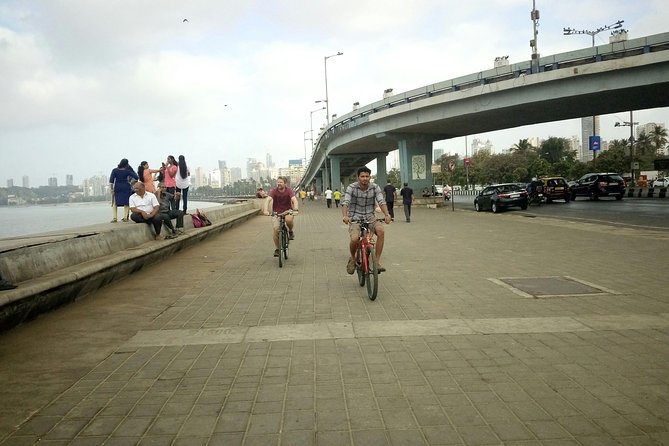
This tour lives or dies on the guide’s ability to connect place to story. The guides on this kind of route aren’t just pointing; they’re giving you the quick mental map you need to understand why each stop belongs in the same ride.
In the tour’s own customer experiences, Roy is highlighted for early-morning guidance around Colaba and nearby areas, with stories that made the city feel more familiar. Another guide, Kurtin, is praised for combining family-friendly pacing with city education during a Christmas ride.
I take that as a sign the best version of this tour is the one where you listen even during the short stops. The route is efficient, so your guide’s explanations are doing most of the heavy lifting.
Safety and comfort: what you should check before you pedal
Biking in a city like Mumbai comes down to comfort with crossings, shared road space, and group riding. One caution from a related cycle experience: a review mentioned no helmets were provided and street crossings felt intense for anyone cautious.
That doesn’t tell me exactly what happens on this specific morning tour, but it does tell me you should treat safety gear as something to confirm. Ask whether helmets are included or optional when you book, and if you have your own helmet, consider bringing it.
Also be honest about your ability. The tour has a minimum age of 6, and that’s a clue that the operator expects participants can manage the bike for the duration. If you’re new to cycling, start slow, keep your line predictable, and let the guide set the rhythm.
Who this tour is best for
I think this tour is especially good if you want a first-pass overview of South Mumbai without turning your day into a transport marathon. It’s also great when you like history, but you also want street life—markets and temples—right alongside the monuments.
It’s a strong choice for:
- Couples or solo travelers who want a guided route with small group size
- Families with kids old enough for the minimum age of 6, especially if you prefer a structured morning activity
- Architecture and city-design fans who like seeing civic buildings and transportation heritage in sequence
It may be a less ideal fit if:
- You’re extremely anxious about traffic or you dislike busy road conditions
- You need long, museum-style dwell time at each stop (this ride is short-stop focused)
Should you book this Mumbai bike tour?
If your goal is to see a lot of South Mumbai in about three hours, this is a smart, cost-controlled way to do it. The pricing works because most stops are free, and you’re buying a guide who ties the route together with real context—not just a list of photo spots.
I’d book if you’re comfortable riding in an urban environment and you like morning sightseeing. I’d think twice if you’re uneasy with street crossings and you can’t confirm helmet availability or you don’t feel confident on a bike.
If you want, tell me your travel dates and your biking comfort level (beginner, intermediate, confident), and I’ll suggest whether this specific style of tour is a good match for you.
FAQ
How long is the bicycle tour in Mumbai?
The tour lasts about 3 hours.
How much does the tour cost?
The price is $39.00 per person.
Where does the tour start, and does it end there too?
You meet at Kailash Parbat Hindu Hotel N Restaurants in Colaba, and the tour ends back at the meeting point.
Are admission tickets included?
Most listed stops show admission tickets free, and the Bombay Panjrapole stop has admission included.
Is pickup offered, and do I get a mobile ticket?
The tour includes pickup offered, and you receive a mobile ticket.
What is the minimum age and group size?
The minimum age is 6 years, and the tour has a maximum of 12 travelers.
What is the cancellation policy?
There is free cancellation up to 24 hours before the experience starts for a full refund.
More Mumbai, Every Kind of Day
- Dharavi slum tour in Mumbai by Female tour guides of the slum
★ 5.0 · 1,976 reviews - Mumbai: Full-Day Sightseeing Tour of Mumbai
★ 4.9 · 1,822 reviews - Private Mumbai Sightseeing Tour (Traveller’s Choice Award Winner)
★ 5.0 · 1,565 reviews - Elephanta Caves & Island Guided Private Tour
★ 5.0 · 1,327 reviews
More Mumbai on Two Wheels
- Mumbai Bicycle Tour
★ 5.0 · 137 reviews - Mumbai: Morning Bicycle Tour
★ 5.0 · 40 reviews - Mumbai: Early Morning Bicycle Tour
★ 4.8 · 30 reviews - Cycling – The Adventurous Islands of Mumbai
★ 5.0 · 25 reviews
New on the Mumbai shortlist

Mumbai by Bicycle, compared.
 ★ 5.0Mumbai Bicycle TourFrom $39137 reviews
 ★ 5.0Morning Bicycle TourFrom $2140 reviews
 ★ 4.8Early Morning Bicycle TourFrom $3730 reviews
 ★ 5.0Cycling – The Adventurous Islands of MumbaiFrom $19925 reviews
 ★ 5.0Early Morning Old Mumbai Private Cycle Tour With BreakfastFrom $6521 reviews
 ★ 4.53 Hours Early Morning in South Mumbai Heritage Bicycle TourFrom $3616 reviews
 ★ 5.0Small-Group Bike Tour of MumbaiFrom $4016 reviews
★ 5.0Mumbai Morning Bicycle TourFrom $1815 reviews
Browse the lists this tour appears in